
Your campaigns are only as smart as the data and decisions behind them
Your marketing team is sending campaigns, but every email goes to a segment, not a person. Your website looks the same for a first-time visitor and a returning customer. A/B tests run occasionally, but there's no structured experimentation programme. And the customer data sits locked in four different platforms that don't talk to each other.
The result? Your competitors feel more relevant to your audience than you do. Not because they have better products, but because their marketing stack actually connects intent to action in real time. This isn't about adding another tool. It's about connecting the ones you have — or replacing the ones that aren't pulling their weight — so that every touchpoint is informed by what the customer actually did.
From campaign blasts to conversations that convert
Marketing automation only works when strategy, data, and platform are aligned. These are the building blocks, engageable separately or as a connected programme.
Strategy
Marketing automation assessment & roadmap
A clear-eyed look at your current stack, workflows, lead scoring, and nurture programmes, with a prioritised plan to close the gaps between what you're doing and what your data could make possible.
Implementation
Adobe Target
A/B testing, multivariate testing, and auto-personalisation — configured with proper hypothesis frameworks, traffic allocation, and statistical rigour so your experimentation programme produces decisions, not just data.
Implementation
RT-CDP
When combined, unified customer profiles, audience segmentation, and cross-channel activation give your marketing team a single, consent-compliant view of every customer that updates in real time, not overnight.
Implementation
Adobe Journey Optimizer
Journey orchestration and real-time decisioning across email, push, in-app, and web. The next best action is triggered by behaviour, not a calendar.
Implementation
Adobe Campaign & Marketo
Email automation, campaign management, and account-based marketing for teams that need reliable execution at scale without outgrowing the platform every eighteen months.
Implementation
Salesforce Marketing Cloud account engagement
Lead management, nurture flows, scoring, and sales alignment — for organisations whose CRM lives in Salesforce and need marketing automation that speaks the same language.
Personalisation
Personalisation & experimentation strategy
Behavioural targeting frameworks, AI-driven recommendation models, and a structured testing programme designed to build an experimentation culture, not just run occasional tests.
Data & integration
Customer data & cross-platform integration
First-party data strategy, consent management, CDP architecture, and the integration layer that connects your automation tools to CMS, commerce, analytics, and CRM. Make your audiences and triggers work across the full stack.
Personalisation that pays for itself in the first quarter
Measured in conversion uplift, engagement depth, and revenue directly attributed to automated journeys. We don’t do vanity metrics.
30%
average conversion uplift from personalisation programmes
Across enterprise clients running Adobe Target and RT-CDP implementations.
4x
return on marketing automation investment
Measured within 12 months of platform go-live across B2B and B2C programmes.
For content workflow orchestration and creative operations, see Content Supply Chain.
A personalisation strategy without unified data is just guesswork with better targeting
Most personalisation efforts start at the wrong end. A team buys a tool, segments an audience, launches a test, and calls it personalisation. But the underlying data is fragmented: web behaviour lives in analytics, purchase history in the CRM, email engagement in the automation platform, and consent status in a spreadsheet someone updates monthly.
The "personalised" experience is built on an incomplete picture of the customer — and, worst of all, the customer can tell. Real personalisation starts with a unified data layer; everything else is sequencing.
CDP & data architecture
First-party data collection, identity resolution, consent orchestration, and real-time profile unification. That’s the foundation that makes every downstream personalisation decision accurate and compliant.
Experimentation infrastructure
Hypothesis management, traffic allocation, statistical significance guardrails, and integration with analytics make testing a repeatable discipline, not a side project.
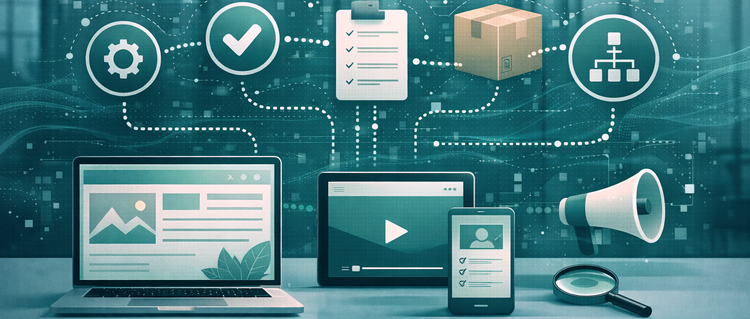
The gap between "we have the tools" and "they're working together" is where revenue leaks
Enterprise marketing stacks are rarely short on capability: Adobe Target can personalise, RT-CDP can unify profiles, Journey Optimizer can orchestrate. The problem is almost never the platform, it's the space between platforms. Audiences built in the CDP don't match segments in the automation tool ,test results from Target don't feed back into journey logic, while campaign performance data sits in a dashboard that nobody connects to revenue attribution.
Closing those gaps — through proper integration architecture, shared taxonomies, and unified measurement — is where the real ROI lives. Not in buying the next tool, but in making the ones you already own actually talk to each other. That's the work that turns a marketing technology stack into a personalisation engine.
Audit the stack, map the gaps, define what good looks like
Before anything gets implemented or reconfigured, the current state needs to be understood. What's working, what's redundant, what's missing, and where the real friction lives between tools, teams, and data.
Marketing technology audit
A full inventory of your current platforms, integrations, data flows, and automation workflows, with a clear assessment of what's delivering value and what's creating drag.
Customer data assessment
An honest picture of your first-party data: where it lives, how it's collected, what consent mechanisms are in place, and how far it is from a unified, activatable customer profile.
Strategy & roadmap
A prioritised plan that connects your commercial goals to specific platform decisions, integration requirements, and a phased delivery timeline built to be defensible in a stakeholder review.
Build the data foundation and connect the platforms
The technical build starts with the data layer. Every personalisation rule, every automated journey, and every test is only as good as the customer profile powering it.
CDP implementation & identity resolution
Unified customer profiles, real-time data ingestion, audience segmentation, and consent management need to be configured so marketing teams can build and activate audiences without waiting on engineering.
Platform configuration & integration
Adobe Target, Journey Optimizer, Campaign, Marketo, or Salesforce Marketing Cloud all need to get tweaked for your use cases and connected to CMS, commerce, analytics, and CRM through a clean integration layer.
Personalisation & testing setup
Targeting rules, recommendation models, and an experimentation framework with proper hypothesis templates, traffic allocation, and statistical guardrails, ready for your team to run with.
Launch campaigns, run experiments, and let the data compound
The platforms are connected and the data is flowing. What follows is the part that actually generates returns: live campaigns, structured experiments, and a continuous feedback loop that gets smarter over time.
Journey activation & campaign launch
First automated journeys and personalised experiences go live with performance baselines established so every future optimisation has something to measure against.
Experimentation programme rollout
A structured testing cadence — not one-off A/B tests, but a prioritised backlog of hypotheses that runs continuously and feeds learnings back into journey logic and personalisation rules.
Training, enablement & optimisation
Role-specific training for campaign managers, analysts, and marketing ops. Full documentation. Ongoing support available as a managed service for teams that want a long-term optimisation partner.
Adobe Target 101 - Part 1: Testing or Personalization?
Adobe Target is a personalization and testing solution and it is a part of Adobe Experience Cloud products suite. Goal of Target is to provide capabilities for customer experience optimization and experimentation across various channels. With the possibility to implement on both client and server side, it offers a robust framework for diverse use cases and activation strategies.
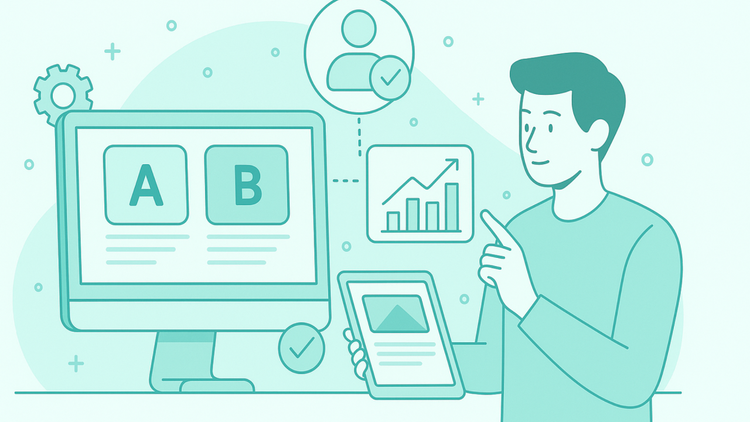
The work speaks for itself
Every project here started with a conversation about a business problem, not a technology wishlist. Have a look at how we think, how we work, and what our clients walked away with.
Get in touch
We start by understanding your goals, then build a clear AI roadmap tailored to you—selecting the right tools, making your data work for you.